Introduction
Finding a lump in the breast can understandably cause concern. However, not every breast lump is cancerous. Benign conditions such as breast cysts, fibroadenomas and other non-cancerous changes can also present as a lump.
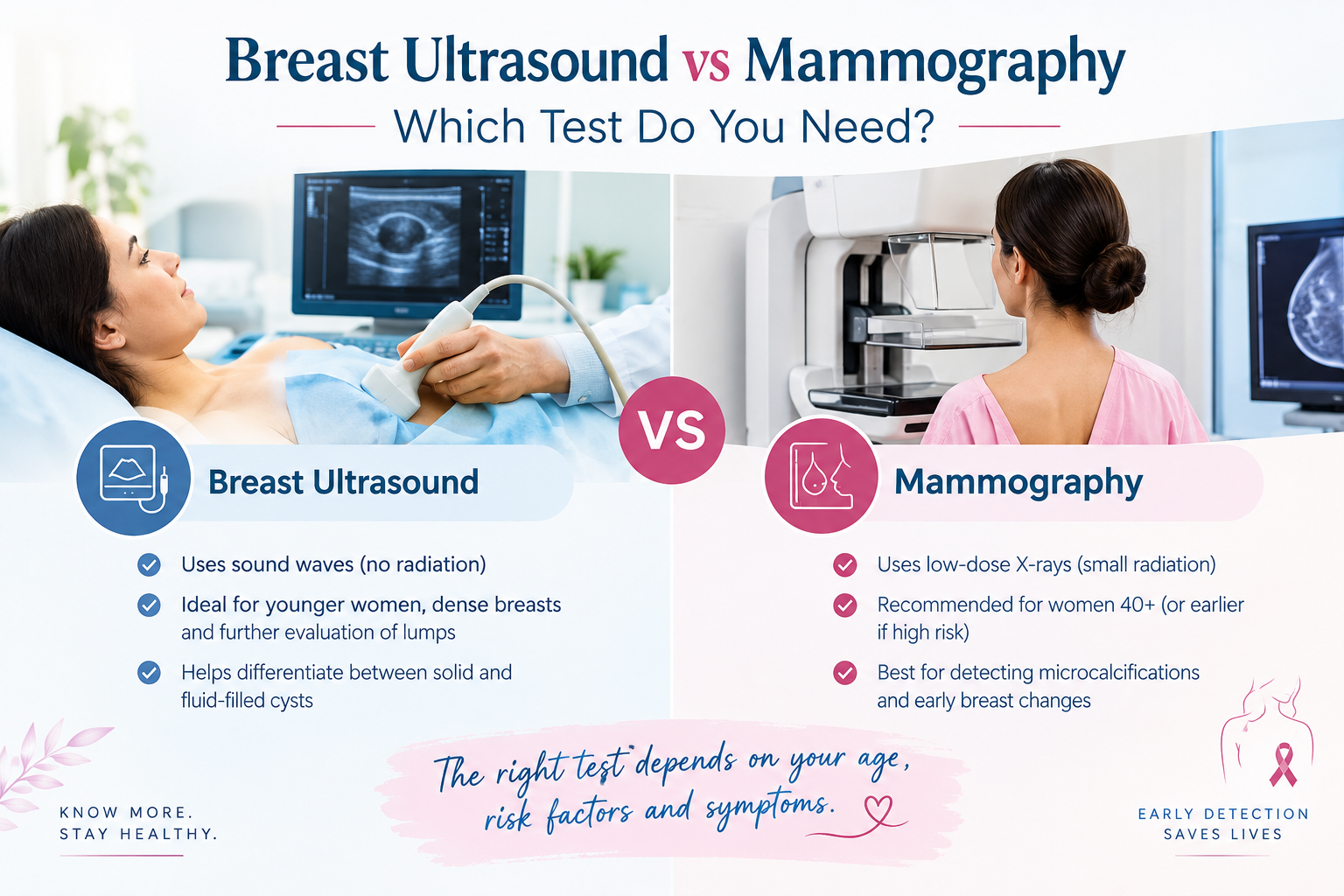
When a breast lump or abnormality requires further evaluation, your doctor may recommend imaging such as breast ultrasound or mammography and, when indicated, a tissue or cell sampling procedure such as FNAC (Fine Needle Aspiration Cytology) or a core needle biopsy.
So, what is the difference between FNAC and core biopsy, and when is each test used?
What Is FNAC of the Breast?
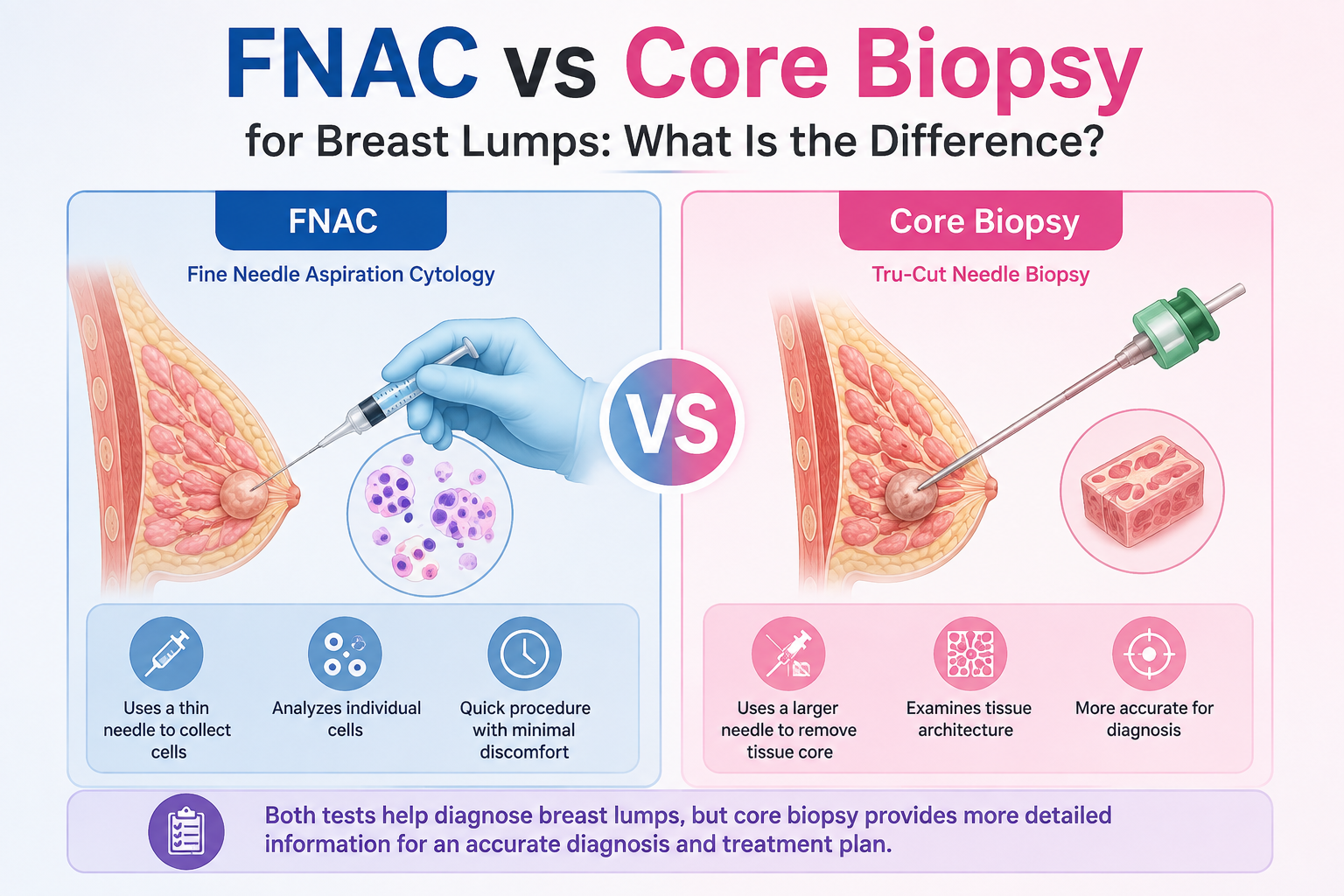
FNAC, or Fine Needle Aspiration Cytology, uses a very thin needle attached to a syringe to withdraw cells or fluid from a breast lump. The sample is then examined by a pathologist under a microscope.
FNAC can be particularly useful for certain cystic breast lesions and in selected situations where examination of cells is sufficient. It may also be used for sampling some suspicious lymph nodes.
Because the needle is very thin, FNAC is generally a quick and minimally invasive procedure. Local anaesthesia may be used when appropriate.
One limitation of FNAC is that it provides cells rather than a larger tissue sample. Therefore, in some suspicious solid breast lesions, FNAC may not provide enough information to establish a definitive diagnosis or perform all the additional tests that may be required.
What Is a Core Needle Biopsy?
A core needle biopsy uses a hollow needle to remove small cylindrical pieces, or “cores,” of tissue from a breast abnormality.
The tissue is examined by a pathologist to determine whether the lesion is benign, atypical or malignant. Because core biopsy provides actual tissue and preserves tissue architecture, it generally provides more diagnostic information than FNAC for a suspicious solid breast lesion.
A core biopsy is commonly performed under ultrasound guidance when the lesion can be seen clearly on ultrasound. Depending on the abnormality, mammography/tomosynthesis or MRI may also be used to guide a biopsy.
Core needle biopsy is often the preferred needle biopsy technique when breast cancer is suspected.
FNAC vs Core Biopsy: What Is the Difference?
Which Is Better: FNAC or Core Biopsy?
There is no single test that is best for every breast lump.
For a suspicious solid breast lesion, core needle biopsy is generally preferred because it provides a larger tissue sample and preserves tissue architecture. It can also provide sufficient material for additional laboratory testing when required.
FNAC can still have an important role in selected cases, particularly when a cystic lesion or another situation can be adequately evaluated with cytology.
Therefore, the appropriate procedure should be decided after proper clinical and imaging assessment rather than by the patient choosing between FNAC and core biopsy.
Does Every Breast Lump Need a Biopsy?
No.
Some breast lumps have imaging and clinical features that are clearly benign and may only require reassurance or imaging follow-up. Other lumps may require additional assessment or tissue sampling.
When a new breast lump is detected, the appropriate approach is usually based on a combination of clinical examination and breast imaging, followed by biopsy when indicated.
A biopsy does not automatically mean that the lump is cancerous. However, when a lesion is sufficiently suspicious, tissue diagnosis may be necessary to establish the diagnosis accurately.
What Is an Ultrasound-Guided Breast Biopsy?
An ultrasound-guided breast biopsy uses real-time ultrasound imaging to guide the biopsy needle into the abnormal area.
For a core biopsy, the skin is usually cleaned and local anaesthesia is administered before the tissue samples are obtained. Several tissue cores may be taken to ensure an adequate sample.
Ultrasound guidance can be particularly useful when the suspicious lesion is clearly visible on ultrasound and allows the radiologist to accurately target the area of concern.
Is FNAC Painful?
FNAC is generally well tolerated and usually causes only mild discomfort. Because the needle is very thin, local anaesthesia may not always be necessary, although it can be used in selected cases.
Temporary bruising or mild soreness can occur after the procedure.
Is Core Needle Biopsy Safe?
Core needle biopsy is a commonly performed minimally invasive procedure. Local anaesthesia is generally used, and most patients can return home after the procedure.
Temporary bruising, swelling, soreness or minor bleeding can occur. Significant complications are uncommon, but your doctor will explain the specific risks and aftercare instructions before the procedure.
When Should You See a Breast Imaging Specialist?
You should seek medical assessment if you notice a new or persistent breast lump, nipple discharge, skin or nipple changes, or an abnormality detected during breast imaging.
A breast imaging specialist can assess the clinical history and imaging findings and determine whether further evaluation, follow-up or a breast biopsy is appropriate.
If you are looking for breast biopsy in Chandigarh, the appropriate procedure—whether FNAC, core needle biopsy or another investigation—should be selected based on the characteristics of the breast lesion and the diagnostic information required.
Breast Biopsy and FNAC in Chandigarh
At Dr. Dua’s Diagnostics & Imaging Centre, Chandigarh, breast lumps and abnormalities can be evaluated using appropriate breast imaging and image-guided diagnostic procedures.
The diagnostic approach may include breast ultrasound, digital mammography and, when indicated, ultrasound-guided FNAC or core needle biopsy.
The aim is to accurately evaluate a breast abnormality and recommend the most appropriate next step rather than treating every breast lump in the same way.
Frequently Asked Questions
| Feature | FNAC | Core Needle Biopsy |
| Sample obtained | Cells or fluid | Tissue cores |
| Needle | Very thin needle | Larger hollow needle |
| Main information | Cytology (individual cells) | Histology (tissue architecture) |
| Particularly useful for | Selected cystic lesions and situations where cytology is sufficient | Suspicious solid breast lesions |
| Local anaesthesia | May or may not be required | Usually used |
| Additional tissue testing | May be limited by small sample | Usually provides more tissue for additional testing |
Is FNAC the same as a core biopsy?
No. FNAC primarily obtains cells or fluid for cytological examination, whereas a core needle biopsy obtains small pieces of tissue for histopathological examination.
Is core biopsy better than FNAC?
For many suspicious solid breast lesions, core needle biopsy is preferred because it provides more tissue and preserves tissue architecture. However, FNAC remains useful in selected clinical situations.
Can a breast lump be benign even if it needs a biopsy?
Yes. A recommendation for biopsy does not mean that the lump is definitely cancerous. Biopsy is performed when tissue diagnosis is required to determine the nature of the lesion.
Is breast biopsy painful?
Most image-guided breast biopsies are performed with local anaesthesia. Patients may experience some pressure or mild discomfort during the procedure, followed by temporary soreness or bruising.
Where can I get a breast biopsy in Chandigarh?
If you have a suspicious breast lump or an abnormal finding on mammography or ultrasound, you can consult a breast imaging specialist in Chandigarh for assessment and advice regarding the appropriate biopsy procedure.