What Is Amniocentesis?
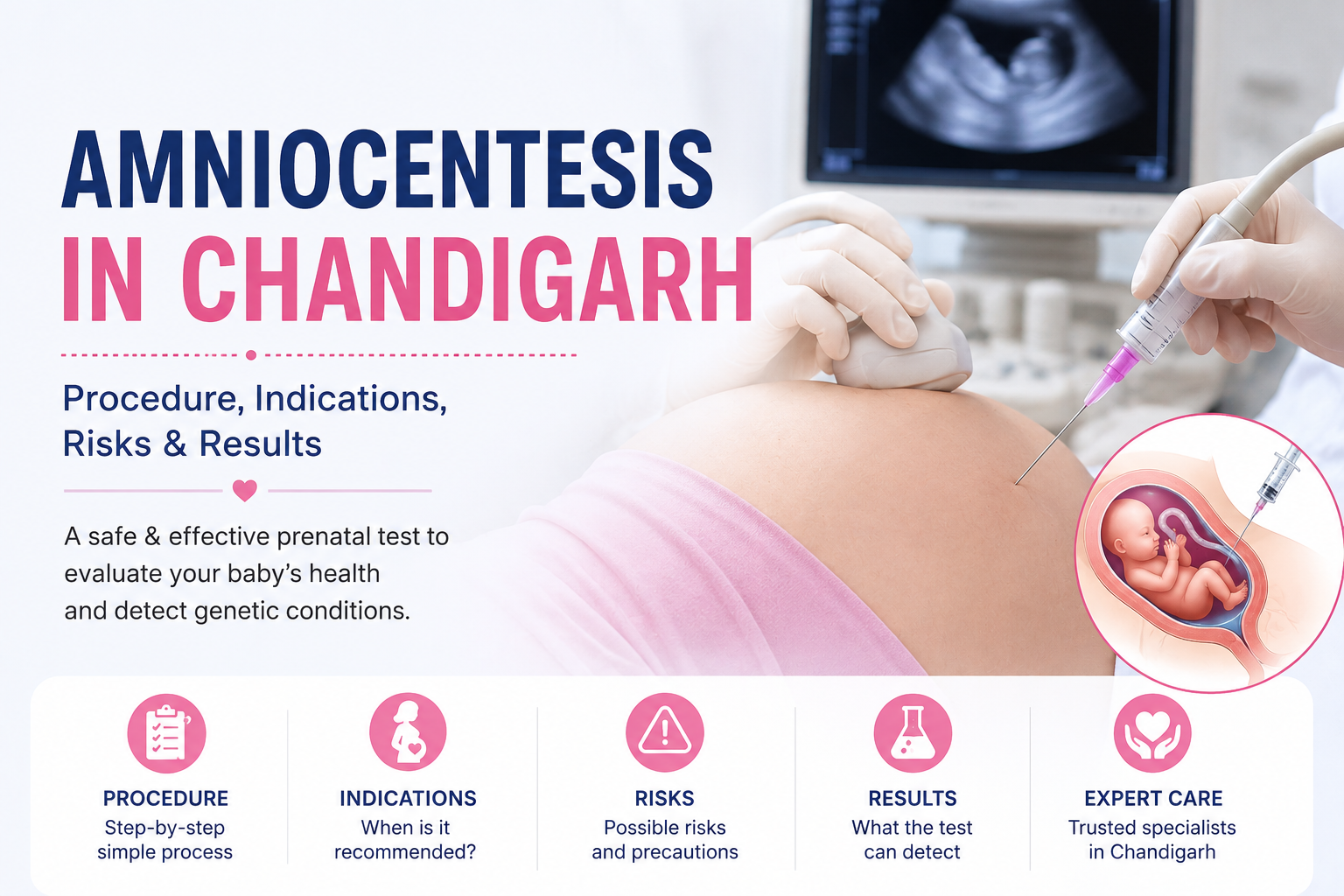
Amniocentesis is a prenatal diagnostic procedure in which a small sample of amniotic fluid is collected during pregnancy and sent for laboratory testing. The sample contains fetal cells that can be examined for certain chromosomal and genetic conditions.
Unlike screening tests, which estimate the likelihood of a condition, amniocentesis is a diagnostic test that can provide more definitive information about specific conditions for which testing is performed.
Patients searching for amniocentesis in Chandigarh are often advised the procedure after an abnormal prenatal screening result, an ultrasound finding, or because of a relevant personal or family genetic history. A consultation with a fetal medicine specialist can help determine whether diagnostic testing is appropriate for an individual pregnancy.
When Is Amniocentesis Recommended?
Amniocentesis is not required for every pregnancy. Diagnostic testing may be considered when there is a specific reason to investigate a possible genetic or chromosomal condition.
Common situations include:
• A high-risk or positive prenatal screening result, including a high-risk cell-free DNA/NIPT result.
• An abnormal ultrasound finding or increased nuchal translucency.
• A previous pregnancy or child affected by a chromosomal or genetic condition.
• A known genetic condition or relevant family history.
• A specific genetic condition for which targeted prenatal testing is appropriate.
The decision depends on the complete clinical picture. A high-risk screening result does not, by itself, confirm that the baby has a chromosomal condition.
Amniocentesis After NIPT or an Abnormal Screening Test
NIPT and other prenatal screening tests estimate the likelihood of certain chromosomal conditions; they do not provide the same level of diagnostic certainty as amniocentesis or CVS.
If NIPT or another screening test is high risk, your fetal medicine specialist may recommend genetic counselling, a detailed ultrasound assessment and diagnostic testing. Amniocentesis is one of the diagnostic options available, depending on gestational age and the clinical situation.
It is important not to interpret a high-risk screening result as a diagnosis. The appropriate next step should be discussed with your obstetrician, fetal medicine specialist or genetic counsellor.
How Is Amniocentesis Performed?
Amniocentesis is performed under continuous ultrasound guidance.
The procedure generally involves:
1. Ultrasound assessment of the pregnancy and identification of a suitable area for sampling.
2. Preparation of the abdomen using appropriate sterile precautions.
3. Insertion of a very thin needle through the abdominal wall into the amniotic cavity under ultrasound guidance.
4. Withdrawal of a small amount of amniotic fluid.
5. Sending the sample to a laboratory for the genetic or chromosomal tests that have been requested.
6. Brief post-procedure observation and instructions from the treating specialist.
The procedure itself is generally short, although preparation and observation may require additional time.
What Can Be Tested Using Amniotic Fluid?
The tests performed on an amniotic fluid sample depend on the clinical indication. Depending on the situation, testing may include chromosome analysis such as karyotyping, rapid testing for common aneuploidies, chromosomal microarray analysis, or targeted molecular genetic testing for a specific suspected condition.
Not every test is appropriate for every pregnancy. The choice of laboratory investigation should be guided by the ultrasound findings, screening results, family history and the clinical question being asked.
Amniocentesis vs CVS
Both amniocentesis and chorionic villus sampling (CVS) are prenatal diagnostic procedures.
The major difference is the tissue sampled. Amniocentesis examines amniotic fluid, whereas CVS obtains a small sample of placental tissue.
CVS can generally be performed earlier in pregnancy, while amniocentesis is commonly performed from around 15 weeks onward. The appropriate procedure depends on gestational age, the suspected condition, the required test and the individual clinical circumstances.
A fetal medicine specialist can explain which diagnostic procedure is more appropriate for your pregnancy.
When Is Amniocentesis Performed?
Amniocentesis is usually performed between 15 and 20 weeks of pregnancy, although diagnostic testing may be performed later when clinically indicated.
The timing should be individualized according to the reason for testing, gestational age, ultrasound findings, screening results and the specific genetic condition being investigated.
Is Amniocentesis Safe?
Amniocentesis is generally considered a safe and highly accurate prenatal diagnostic procedure, but it is an invasive test and is not completely risk-free.
Possible complications include a small risk of pregnancy loss, leakage of amniotic fluid and minor bleeding. Infection and other complications are uncommon.
The individual risk depends on the clinical circumstances and the procedure. Your fetal medicine specialist should explain the potential benefits, limitations and risks before the procedure so that you can make an informed decision.
What Happens After Amniocentesis?
After the procedure, the sample is sent to the laboratory for the tests that have been requested. Depending on the type of analysis, results may be available at different times, ranging from rapid preliminary results to several weeks for some tests.
Your doctor will explain the results in the context of your ultrasound findings, screening results and other clinical information. A normal result is reassuring for the conditions tested, but no prenatal genetic test can exclude every possible genetic or developmental condition.
Choosing an Amniocentesis Centre in Chandigarh
If you are looking for an amniocentesis centre in Chandigarh, it is important to consider more than the procedure itself.
You may wish to ask:
• Is the procedure performed under ultrasound guidance?
• Is the procedure performed by a doctor experienced in fetal medicine and invasive prenatal diagnosis?
• Will the indication for testing be reviewed before the procedure?
• Will appropriate genetic testing be selected according to the clinical situation?
• Will the results be explained in the context of the ultrasound and pregnancy?
For patients from Chandigarh, Mohali, Panchkula and the wider Tricity region, access to appropriate fetal imaging, counselling, invasive prenatal diagnosis and laboratory coordination can be an important part of prenatal care.
Amniocentesis in Chandigarh – Dr. Ashish Dua
Dr. Ashish Dua is a radiologist and fetal medicine specialist offering detailed prenatal imaging and ultrasound-guided invasive prenatal diagnostic procedures in Chandigarh.
If you have been advised to undergo amniocentesis in Chandigarh, a consultation can help you understand why the procedure has been recommended, what diagnostic information is required, which laboratory tests may be appropriate and what the potential benefits and risks are.
At Dr. Dua’s Diagnostics & Imaging Centre, prenatal imaging and fetal medicine services are focused on providing detailed assessment and appropriate counselling before invasive prenatal diagnostic procedures.
Dr. Ashish Dua
Fetal Medicine & Breast Radiology
Dr. Dua’s Diagnostics & Imaging Centre, Chandigarh
Diagnosis Before Birth. Detection Before Symptoms.
Frequently Asked Questions About Amniocentesis
Is amniocentesis painful?
Some women experience mild discomfort, pressure or brief pain during the procedure. Your doctor will explain what to expect before the procedure.
How long does amniocentesis take?
The procedure itself is generally short, although preparation and post-procedure observation may take additional time.
Is amniocentesis required in every pregnancy?
No. It is a diagnostic test considered when there is an appropriate clinical indication. Prenatal screening and diagnostic testing options should be discussed individually.
Is amniocentesis done under ultrasound guidance?
Yes. Ultrasound is used to guide the procedure and help the specialist identify an appropriate area for sampling.
If my NIPT is high risk, do I need amniocentesis?
A high-risk NIPT result is a screening result, not a diagnosis. Diagnostic testing such as amniocentesis or CVS may be discussed to obtain more definitive information, depending on gestational age and the clinical situation.
When can I have amniocentesis?
It is commonly performed between 15 and 20 weeks, although the timing can vary according to the clinical indication.
Is amniocentesis safe?
It is generally considered safe, but it carries a small risk of complications including pregnancy loss, fluid leakage and bleeding. Your individual risk should be discussed with your treating specialist.